
.png) 2 months ago
45
2 months ago
45
ARTICLE AD BOX
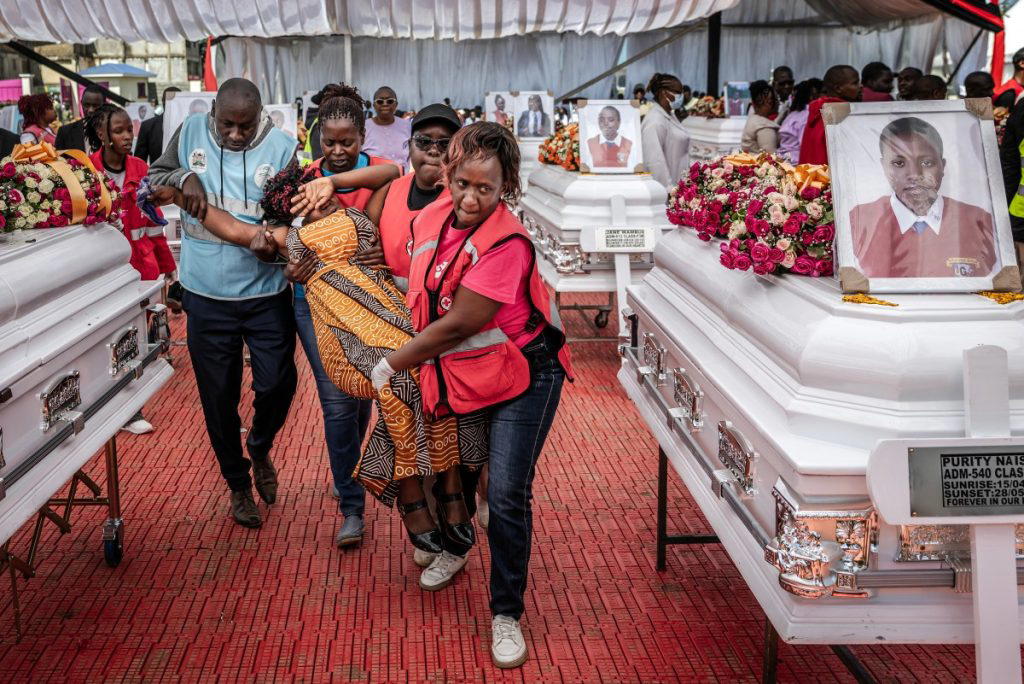
Almost 50 fires have struck Kenyan schools this year, killing 16 schoolgirls and forcing more than 100 schools to close temporarily. The crisis is widely recognized, yet solutions remain scarce.
Many attribute Kenya’s alarming trend of arson to an education system strained by chronic underfunding and corruption.
These problems are worsened by the widespread preference for boarding schools—a legacy of British colonial rule—where children often live for months away from their families in institutions that tend to be overcrowded, underfunded, and prone to abuse.
On May 28, 16 girls were burned alive when the dormitory at Utumishi Girls’ Academy in Nakuru County was set on fire at night. Nine of their classmates are currently under investigation.
Tasha, 15, survived after friends forced a door that had been locked from the outside—contrary to fire regulations—open.
She told AFP that rumours of dissatisfaction with school conditions and plans for a strike had circulated among the girls.
“I didn’t think they would go that far,” she said at a memorial service for her lost friends.
Psychologist Catherine Gachutha, former chair of Kenya’s Counselling and Psychological Association, said teenagers are usually not malicious but often fail to consider the consequences of their actions.
Many appear to be copying incidents at other schools and may also be mirroring the violent protests that have erupted across Kenyan streets over government corruption and economic stagnation, which frequently involve arson of public spaces and businesses.
Political factors also play a role: Kenyan children face intense exam pressure in an economy where only 10 to 20 percent of the workforce holds formal employment.
“These are young people who are going through a school system that is not giving them jobs,” Gachutha said, adding that fires can be a form of rebellion against the government.
– ‘Cash cow’ –
Few are willing to speak openly about the underlying problems.
AFP visited the smouldering ruins of a dorm at Gathiruini Boys Secondary School in Kiambu County earlier this month, where a fire had fortunately left no casualties.
Teachers and local education officials all declined to comment.
One experienced principal of a boarding school in western Kenya agreed to talk to AFP anonymously, citing the risk of disciplinary action for speaking to the media.
He said he had recently been forced to send all his pupils home after receiving an anonymous note threatening “action.”
“There is a lot of blackmail from these teenagers now,” he said, blaming a culture of “over‑entitled” children.
He also highlighted the larger issue of consistent delays and shortfalls in government funding, including “misuse” by officials.
“Greedy” headmasters, he added, oversubscribed some schools to obtain more cash, forcing pupils to sleep in converted cafeterias or corridors, in violation of safety guidelines.
“The teaching fraternity has turned schools into a cash cow,” agreed a parent, also speaking anonymously for fear of repercussions.
– ‘Haven’t learned’ –
There is also a lack of basic safety measures, according to multiple emergency responders.
“Many schools simply cannot afford a robust fire response plan,” said Isaac Maina, head of national operations at G4S, one of Kenya’s largest private fire response companies.
George Ndege, head of the Architectural Association of Kenya (AAK), said school boards believed that preventing students from sneaking out was more important than their safety, leading to grilled windows and barricaded dormitory doors.
AAK has identified 55,000 public schools with “deplorable conditions” and has vowed to revamp them, but Ndege said the work would take years.
President William Ruto’s government said this week it would not provide financial bailouts for affected schools, leaving the costs to parents, though it has pledged a taskforce to examine the factors behind school fires.
Similar promises have been made in the past.
After a dorm fire killed 21 boys in 2024, the education ministry ordered 348 boarding schools to convert into day schools for safety reasons.
It is unclear whether this directive was ever implemented. The ministry did not respond to AFP’s request for comment.
“Fire is not a yesterday phenomenon. It’s not an issue that is coming to surprise people,” said Peter Kinyanjui, who survived a school fire when he was a teenager some 20 years ago.
“We haven’t learned the lessons.”
AFP
The post Why Kenyan kids are burning schools, killing classmates appeared first on Vanguard News.




 English (US) ·