
.png) 2 months ago
43
2 months ago
43
ARTICLE AD BOX
By MARGEE ENSIGN
I have led universities on three continents—Africa, North America, and, most recently, Europe at the American University in Bulgaria (AUBG). Yet I will never forget the rapid, intense experiences I had at the American University of Nigeria, Yola.
The AUN, where I served as president from 2010 to 2017 and again from 2021 to 2022, is clear in its mission to be “Africa’s development university.” It aims to ensure that the local community and the surrounding impoverished region benefit from university programs and projects.
At AUN, this mission shaped how we designed curricula, recruited students and faculty, and communicated with students, parents, and sometimes skeptical or hostile host societies that were unclear about or suspicious of an American education. For several years, our survival depended on believing in, telling, and living a coherent and compelling story. When Boko Haram—whose Hausa name roughly translates as “Western education is evil”—threatened us, the mutually supportive and trusting relationship we built with the local community kept us safe and allowed us to pursue our development mission.
AUN was only six years old when I became president. Located in rural, desperately impoverished, largely Muslim northeastern Nigeria, the university might not have survived financially or physically without a community network established before the crisis began. We also hired and trained an armed security force of more than six hundred people.
In 2012, the Nigerian government removed fuel subsidies, sparking nationwide strikes. In response, AUN led the creation of the Adamawa Peace Initiative (API), bringing together local Muslim and Christian leaders, businesspeople, and youth leaders for the first time. We agreed on values and goals that guided our work for five years: youth must be positively engaged; religion is an instrument of peace; women are the center of development; and education is the foundation of society.
We agreed that these community leaders best understood the needs of our poor community. Based on their concerns, we chose our first project to focus on the most vulnerable youth. Through the Feed and Read program, we reduced hunger and increased literacy among street children (the Almajiri), who were easily recruited by Boko Haram. We hired local women to cook daily meals, and our students taught the children literacy and numeracy.
We also established the Peace through Sports program, which brought together youth from different cultural and religious backgrounds to play football. Most participants were identified by API members. Our Technology-Enhanced Learning for All (TELA) initiative taught more than twenty thousand internally displaced children how to read via a radio program. The curriculum for the radio program was developed in an AUN media class. All these efforts were fully integrated into newly established community‑based university development courses, in which students, faculty, and sometimes staff identified a local problem—hunger, illiteracy, environmental degradation, poverty—and faculty then developed a curriculum focused on proposed solutions.
Additionally, API members informed us that local hospitals had unreliable internet service and that health‑care providers needed access to research on emerging diseases. In response, AUN launched the Library on a Flash (Drive) program, through which librarians uploaded desired articles and books onto flash drives and sent them to hospitals and clinics in the region.
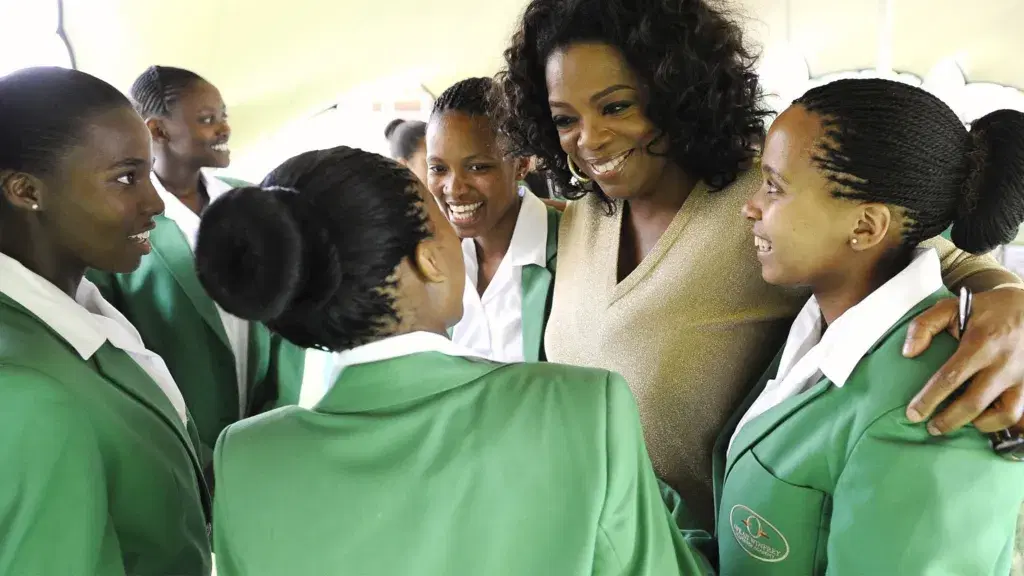
The American University of Nigeria granted scholarships to twenty‑one young women who escaped Boko Haram militants. The scholar pictured above is one of the recipients.
Thus, even before Boko Haram intensified its terror of regional communities with bombings and kidnappings, we had built strong, trusting relationships with local leaders. They were the ones who alerted us to the intensifying threat of Boko Haram nearby.
I will never forget the call in fall 2014 from the emir of Mubi, a city north of us: “Margee, can you please come and bring the API members with you?” We all drove together in a bus, and when we arrived, we found a room full of about five hundred women and girls. I asked our translator, “Where are the boys and men?” One of the women replied, “Boko Haram killed our husbands and kidnapped our boys.” This situation served as an early warning that allowed us to prepare for what was coming. On the bus home, Imam Dauda Bello, a prominent API member, said to me, “We must be obsessed with peace,” and we were, for years.
Later in 2014, when close to 300,000 refugees poured into our small city to flee Boko Haram’s escalating bombings and kidnappings, we had strong relationships to draw upon and an institutional structure to help us feed and house the refugees. When a local university north of us was destroyed, we opened our classrooms and residence halls to its students so they could finish their school year.
At all the universities I have led—especially in Nigeria—every department embedded a community‑based project in its curriculum. These included entrepreneurship and social entrepreneurship courses mainly for women in Yola and sustainable agriculture courses that taught basic principles and practices to farmers. In addition, every afternoon after classes, AUN students, faculty, and staff participated in what we called the “feeding,” during which we distributed food to approximately fifty thousand people per day.
Even today, far from Yola in northern Nigeria, I remember with nostalgia something one of my Nigerian students from the town of Chibok told me. After rescuing her from Boko Haram kidnappers, we brought her to the American University of Nigeria. Upon graduation, she said words that I carry with me every day: “Education gives me the wings to fly, the power to fight, and the voice to speak.”
• Ensign, a former president of the American University of Nigeria, Yola, is currently a senior fellow at the Center for Civic Engagement at Bard College, USA.



 English (US) ·