
.png) 3 months ago
52
3 months ago
52
ARTICLE AD BOX
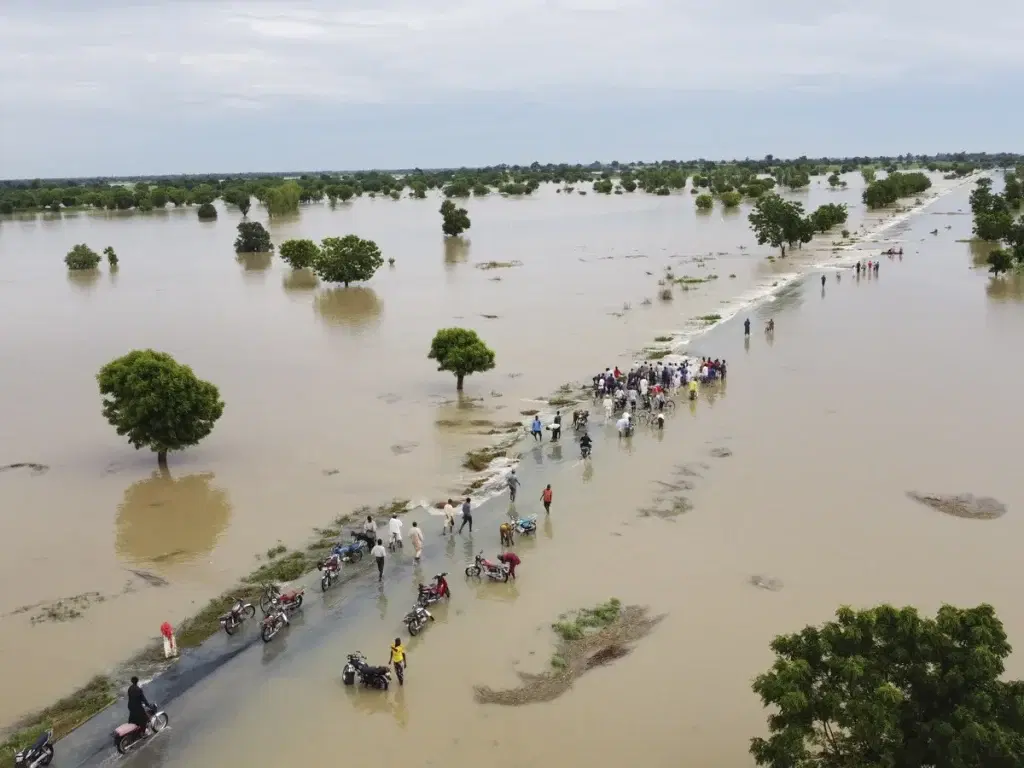
The Yobe, Adamawa, and Borno state governments have introduced a range of emergency response plans to address the looming flooding threat in their territories.
These measures were announced during a briefing with the News of Nigeria (NAN) following a survey that assessed each state’s readiness to manage the natural disaster.
NAN reported that the Nigerian Meteorological Agency (NiMet) and the Nigeria Hydrological Services Agency had previously warned of floods, winds, storms, and prolonged dry spells in various parts of the country.
Dr Ibrahim Jalo, Director of Search and Rescue Operations at the Yobe State Emergency Management Agency (YOSEMA), explained that the agency had deployed real‑time river‑monitoring digital platforms in riverine communities.
Jalo said the agency had engaged key stakeholders—including security forces, ministries, disability groups, and humanitarian partners—to strengthen disaster response.
The director added that Local Government Area Early Warning and Action Committees had been activated and trained to improve grassroots emergency response.
He noted that the state government had instructed YOSEMA to reserve relief materials and food items for 60,000 households.
Jalo also mentioned that 7,400 sandbags had been earmarked for building embankments in vulnerable communities.
According to him, relief supplies are being positioned in Damaturu, Potiskum, and Geidam to ensure rapid access during emergencies.
Jalo said the agency had mapped community leaders and emergency contacts to improve communication and reduce response times during disasters.
The director further revealed plans to evacuate residents from 12 flood‑prone areas to higher ground.
He identified safe locations for evacuees in Gujba, Damaturu, Bursari, Geidam, Yunusari, Fika, Potiskum, Jakusko, Bade, Gulani, Karasuwa, and Machina.
Jalo urged residents to heed early warning information and cooperate with emergency officials during potential evacuations.
In Adamawa, the government announced that it will soon begin demolishing houses built on waterways as part of flood‑mitigation efforts.
Mrs Syngana Dahdah, Permanent Secretary of the Ministry of Environment, told NAN that residents whose houses had been earmarked for demolition and compensation must vacate immediately.
She said the ministry had forwarded a memo to Governor Ahmadu Fintiri regarding the desilting of drains in Yola and the reconstruction of drainage along the Shagari and Yolde Pate axes.
Dahdah noted that these areas experienced severe flooding in 2025 due to blocked drains and poor water flow.
The permanent secretary said the ministry had also arranged for the demolition of embankments built on some farms for irrigation, as these structures were constructed on waterways and contributed to flooding in parts of the state.
Meanwhile, the National Emergency Management Agency (NEMA) has just finished an awareness campaign on disaster preparedness, early warning systems, and risk‑reduction measures in Yola‑North and Yola‑South local government areas.
Mr Suleiman Yakubu, NEMA Zonal Director, told NAN that the exercise was part of the ongoing National Preparedness and Response Campaign (NPRC) 2026.
He said the sensitisation, which focused on flooding and related hazards common during the rainy season, benefited the communities of Makama, Mbamba, Angwan Tarbo, Shagari, Rimawa, and Gbonrinji.
In Borno, hundreds of residents have been evacuated from the flood‑prone community of Dikwa to safer shelters to reduce their exposure to recurring seasonal flooding.
Ali Abdullahi, Director‑General of the Borno State Emergency Management Agency (SEMA), said the intervention was part of a broader disaster‑risk‑reduction strategy aimed at protecting lives and property.
He added that the agency continued to provide food and other relief materials to residents of the Kala Balge community, which has struggled with annual floods due to water released from Cameroon.
Abdullahi said massive drainage clearance was carried out in Maiduguri to prevent blockage of waterways.
The director‑general noted that major flood‑prone areas—Ajilari Cross, Kopa, and Bulumkutu‑Dala—had received targeted interventions, including drainage desilting and the construction of improved drainage infrastructure.
“Ajilari Cross, Kopa and Bulumkutu‑Dala remain some of the most vulnerable areas during the rainy season,” he said. “We are currently expanding drainage systems and clearing blocked waterways to reduce the impact of flooding.” (NAN)
The post Flood: Yobe, Adamawa, Borno unveil emergency response strategies appeared first on Vanguard News.





 English (US) ·