
.png) 3 months ago
47
3 months ago
47
ARTICLE AD BOX
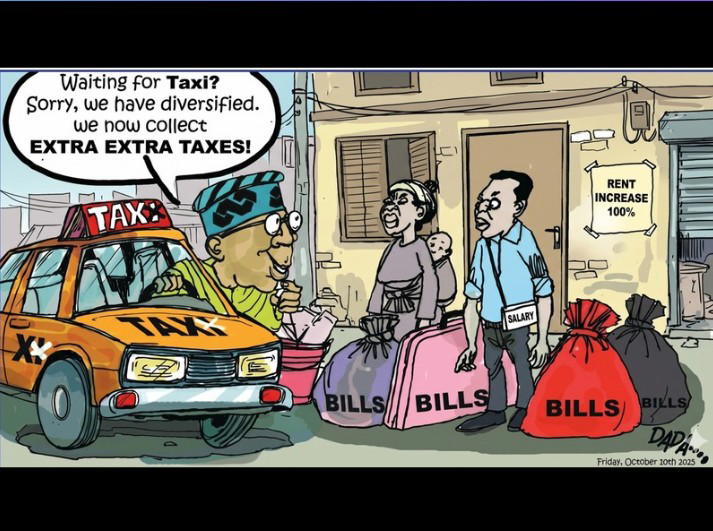
In Education, Health, Judiciary and Rule of Law, Fiscal policies, Insecurity, Religious Harmony, Sports, Politics, Infrastructure, Corruption, Agriculture, Oil and Gas, and Power, members of the Vanguard Board of Editors have assessed Tinubu’s three years in office. While there is a general sense that he is attempting to serve the nation, a more troubling consensus is that problems persist. But who will tell the President?
Hope! Renewed Hope! Perhaps the writer who said hope is better served as breakfast rather than dinner did not have President Bola Tinubu in mind. Three years, or 1095 days, later, the President’s advisers still tell Nigerians that their hope will be renewed. While Tinubu himself acknowledges the suffering of Nigerians – or so he claims from time to time – some of his advisers speak a different narrative about the state of the nation.
Some even claim that Nigeria today is the best it has been since independence, while simultaneously praising Tinubu as the best President Nigeria has ever had. This is where some of President Tinubu’s challenges begin. If a leader is not held accountable by his advisers and associates, and made to understand the lived realities of his citizens, he may continue as if everything is fine.
For some Nigerians, whenever they see President Tinubu, the image that confronts them is that of an unsympathetic leader. Partisans may disagree, but that is the perception for many. The result is that, although Tinubu is trying to do his best, to correct what has taken decades to damage, and to implement dynamic strategies for reform, there is a disconnect between effort and outcome.
But who will tell the President?
Who will tell the President that Nigerians are suffering under the weight of his reforms?
Who will tell the President that the lifestyles of some of his appointees and friends do not reflect the hardships Nigerians are enduring?
Who will tell the President that awarding multi‑trillion naira legacy contracts – in the tens of trillions – to a single contractor suggests self‑sabotage and is antithetical to inclusivity?
Who will tell the President that the palliatives his administration claims to provide are largely driven by partisan considerations?
Who will tell the President that the cries of hunger and poverty have grown louder because what should have been distributed is concentrated in the hands of a few?
Who will tell the President that, of all he has done, he has yet to convince some Nigerians that he means well?
Who will tell the President that the lifestyle of his son, Seyi, does not reflect the sacrifices the President demands of his fellow countrymen?
Who will tell the President that he has the most distinguished influence to make Nigeria better, yet there are fears his focus is mainly on political survival and domination?
Indeed, who will tell the President to use his unmatched influence over the legislative and judicial branches to establish a system that works for all, not just for his All Progressives Congress (APC) leaders, members, and a close circle?
But who will tell the President that a good legacy, rooted in the virtues of Ubuntu – the African philosophical worldview that emphasizes the universal bond of sharing, summarized by “I am because we are” – is worth far more than wealth and bragging?
Who will tell the President?
Who will tell the President that history beckons and that he still has time to record his name as the best President Nigeria has ever had, if only he can forego some personal political gains made possible by the conduct of his associates, and present himself as a leader truly committed to the overall sanitisation of Nigeria’s political sphere? Umaru Musa Yar’Adua ruled Nigeria for only two years before health challenges halted his vision. He is still remembered for his humility and gestures that suggested he wanted a better political space for all.
Who will tell the President that, after three years in office, the democratic space has shrunk for the opposition to thrive?
Who will tell the President that his command‑style political practice is not sustainable in a polity of constantly clashing socio‑political, economic and religious interests?
Who will remind the President of his promise to provide power and stop estimated billing?
There is a common saying that ‘nothing lasts forever’. From all indications, barring any last‑minute reassessment of his engagement, and if opposition figures coalesce behind a candidate to stop Tinubu, the incumbent is set to retain his seat and serve a second term. In any case, what content are those seeking to unseat Tinubu within the praxis of Nigeria’s political space, history and networking?
In Tony Blair’s A JOURNEY, the former British Prime Minister discusses fear and courage in Chapter II, The Apprentice Leadership. He notes that the journey from opposition to government can feel like a short time, yet each day drags, each week brings new anxiety, each month a fresh challenge, and each year a new height to attain so that momentum is not lost. He writes that later, one learns courage in different situations: the first time onstage, when you wish you had never agreed to do it, you curse your pretensions and lament your ego, and want only to go back into the corner.
In terms of courage, Tinubu demonstrated uncommon, “incubus” courage by removing the fuel subsidy from day one, while also throwing the Nigerian workforce into unprecedented despair. Unfortunately, Tinubu himself became a victim of that courage because the esteem and progressive results that some of his policies could have birthed have not eased the excruciating suffering of the masses.
To be fair, Tinubu cannot simply be written off as a failure. In the following pages, you will read about his achievements in some sectors of the economy: the tax bill, increased revenue, NELFUND, loans to industries, stabilisation of the exchange rate, local government autonomy, regional development commissions, mining reforms, Lagos/Calabar Coastal Road, Badagry/Sokoto Highway, ports’ rehabilitation – just a few of the initiatives the Tinubu administration has launched.
The challenge is that Nigerians are said to be getting poorer while governments at all levels are getting richer and awash with cash. Which economic paradigm results in the impoverishment of the people while the government meant to serve them gets richer in quantum leaps? Again, who will tell the President about this?
In the following pages, there are articles assessing Tinubu’s performance, using his Renewed Hope Manifesto as a pivot. In Education, Health, Judiciary and Rule of Law, Fiscal policies, Insecurity, Religious Harmony, Sports, Politics, Infrastructure, Corruption, Agriculture, Oil and Gas, and Power, members of the Vanguard Board of Editors have assessed Tinubu’s three years in office. While there is a scant agreement that he is trying to do his best for the nation, the more troubling consensus is that problems persist. But who will tell the President?
The post Tinubu’s 3rd Anniversary: Prologue – The eve of reckoning: Who will tell the President? appeared first on Vanguard News.





 English (US) ·