
.png) 4 months ago
42
4 months ago
42
ARTICLE AD BOX
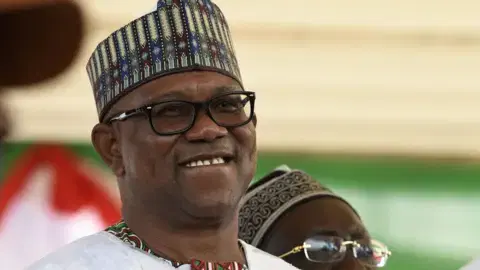
By Valentine Obienyem
The political journey of Mr. Peter Obi—from the All Progressives Grand Alliance (APGA) to the People's Democratic Party (PDP), then to the Labour Party (LP), and most recently to the African Democratic Congress (ADC)—is more than a series of party switches. It is the story of a man who has tried to keep his convictions intact in a political landscape where corruption is entrenched and moral imagination is eroded.
Read Also: 2027: I’ll not step down for Atiku, Amaechi, anyone — Hayatu-Deen, ADC presidential aspirant
Obi did not emerge from the conventional Nigerian political machine. He was not shaped in the “dark schools” where intrigue is mistaken for wisdom and power is pursued without ethical restraint. He entered politics late, reluctantly, and almost philosophically. According to him, the turning point came during a conversation at the Kellogg School of Management. After a long dinner, a lecturer praised his breadth of knowledge and urged him to return to Nigeria to serve the public. The counsel was simple yet profound: private wealth may enrich an individual, but public wealth enriches civilisation.
This advice resonated with a mind already troubled by the nation’s decline. Obi returned to a political environment that had become highly transactional, where parties lost ideological identity and public office was increasingly seen as a means of personal gain. Nevertheless, he entered public life with earnestness, travelling from town to town, from village square to market assembly, preaching prudence, accountability, and disciplined governance with almost evangelical zeal. He embodied the spirit of a reformer: hopeful, austere, and convinced that governance could still be moral.
He first found a political home in APGA, a party then driven by regional renewal idealism. For him, APGA was not merely a party but a school of political formation. Through bitter litigation and exhausting legal battles, he secured the governorship of Anambra State and emerged with the reputation of a man who had wrestled authority from entrenched forces through perseverance.
His tenure reshaped both his reputation and APGA’s fortunes. While many governors treated public resources as spoils of conquest, Obi governed with restraint, emphasizing savings, investment in education, infrastructure, and institutional discipline. Even critics were often forced to acknowledge his frugality and administrative prudence. Under his leadership, APGA expanded its influence; another governor emerged under its colours; legislators entered the National Assembly bearing its banner. Obi devoted himself to consolidating the party’s future in Anambra, believing that institutions nurtured by sacrifice would naturally produce loyalty.
However, Nigerian politics rarely rewards competence or restraint. The very party Obi strengthened gradually became hostile to him. Suspicion replaced camaraderie; envy displaced trust. Tensions with his successor began almost immediately after the handover. Following a private meeting at the Onitsha Government Lodge, anonymous newspaper advertisements appeared accusing him of greed and warning him away from the state he had governed. This marked the start of a political war in which yesterday’s ally became today’s persecutor.
The conflict deepened until peace required Obi’s departure from APGA. He left with disappointment and a painful lesson about the fragility of political loyalty in Nigeria, and joined the PDP, then the dominant force in Nigerian electoral politics.
By 2019, Obi’s influence had crossed regional boundaries. Selected as Alhaji Atiku Abubakar’s running mate, he brought a reputation for prudence, managerial competence, and moral seriousness to the campaign. Even critics conceded that the ticket gained unusual vitality from his presence.
Yet as he moved deeper into national politics, he encountered the corrosive monetisation of democratic life. During the 2022 electoral season, he warned against turning politics into commerce, arguing that public office must never become an auction where mandates are sold to the highest bidder. By then, Nigerian politics had become saturated with transactional culture. Delegates expected inducements; parties functioned as marketplaces; ideology had surrendered to financial power.
Obi found himself confronting a system where corruption was no longer an isolated vice but an organising principle of political life. It had become institutionalised and woven into ambition’s structure. To resist it invited hostility from those who benefited from its networks.
Unable to reconcile with that culture, he left the PDP and joined the Labour Party, then a peripheral party. The move astonished observers. The “Obidient” movement grew rapidly. Young Nigerians, weary of corruption, unemployment, and elite indifference, rallied around him with extraordinary passion. Labour, once electorally obscure, became a national force overnight. Unknown candidates rode that energy into public office. For the first time, crowds gathered not because they were bribed or coerced, but because they believed.
Every reforming movement, however, provokes resistance from entrenched interests. Internal divisions soon emerged within Labour. Litigation multiplied. Factions appeared like cracks in a rising edifice.
Obi’s supporters believed that hostile forces had infiltrated the party to weaken it from within, arguing that institutions are more easily destroyed by internal corrosion than external assault. Many came to view the crises as deliberate attempts to frustrate any insurgent political alternative capable of threatening the established order.
The controversies surrounding the Independent National Electoral Commission deepened suspicion. Court judgments remained unresolved; procedural delays had political consequences; uncertainty became a strategic weapon. To Obi’s admirers, these were not mere administrative failures but symptoms of a political order fearful of genuine reform. Meanwhile, insiders in INEC revealed plans that appeared to follow a script from Aso Rock.
From Labour he moved to the ADC, hoping for a more stable platform. Yet familiar storms gathered again. Dormant disputes resurfaced; litigations multiplied; uncertainty returned. Critics accused him of inconsistency and argued that he ought to remain and fight indefinitely within any party he joined.
Such criticisms often ignore the magnitude of forces opposing reform in Nigeria. When corruption becomes systemic, resistance requires not only courage but prudence. As Aristotle observed, courage without wisdom degenerates into recklessness. A man who charges blindly against overwhelming danger may appear bold yet accomplish little beyond self‑destruction. Obi’s political movements can therefore be seen as strategic repositioning within an unstable and hostile terrain.
His enduring strength lies not merely in ambition but in discipline. After elections, he does not retreat into bitterness or luxury; instead he visits schools, hospitals, and communities, supports the vulnerable, and advocates reform. In an age where politics






 English (US) ·