
.png) 2 hours ago
1
2 hours ago
1
ARTICLE AD BOX
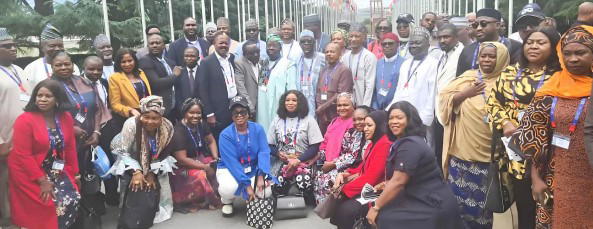
By Victor Ahiuma-Young, GENEVA, Switzerland
As artificial intelligence reshapes workplaces worldwide, governments are confronting a key question: how can societies adopt technological innovation while safeguarding jobs, workers’ rights and economic inclusion?
Read Also: Global Award: Arrests, intimidation won’t stop us until workers are free — Ajaero
During the 114th Session of the International Labour Conference (ILC) in Geneva, Nigeria joined a growing list of countries calling for a human‑centred approach to the future of work.
The country warned that unchecked AI adoption could deepen inequality and displace millions of workers.
Addressing delegates from governments, employers and labour organisations worldwide, head of the Nigerian delegation and Minister of Labour and Employment, Dr. Muhammad Dingyadi, urged policymakers to strike a careful balance between innovation and worker protection. He stressed that the choices made today will determine whether AI strengthens or weakens the dignity of labour in the years ahead.
According to him: “The world is moving forward at a rapid pace, driven by advances in artificial intelligence, AI, and we, as an organisation, must embrace this progress. While welcoming the positive transformations that AI offers, we must also carefully consider the uncertainties that accompany these developments.
“The Director‑General’s ILO report has highlighted changes that we are already aware of and are likely experiencing in our respective countries. These include the expansion of labour markets and economies, changes in the organisation of work, the emergence of new forms of employment relationships, and technological advancements that drive policy and institutional innovation. While these shifts bring significant benefits, they also cast a shadow of uncertainty.
“Where AI creates new opportunities and jobs, there may also be job displacement and losses. Where digital and high‑tech infrastructure expands, there may be a decline in traditional roles and a reduced value placed on human contributions within the work process. We therefore need a balanced approach that ensures that, while harnessing the benefits of AI, we do not undermine the gains made in promoting decent work in our societies.
“The Federal Government of Nigeria was quick to recognise the critical role and immense potential of AI and technological transformation in driving national growth and development. This recognition informed the establishment of the Federal Ministry of Communications, Innovation and Digital Economy, which is responsible for driving the strategic blueprint for a digitally prosperous Nigeria.”
The Minister made it clear that “by aligning these principles with national priorities, we can harness AI’s benefits while preserving decent work in the world of work. This is a moment of choice, and the choices we make today will determine whether technological advancement strengthens or weakens the dignity of labour for generations to come.”
Make workers disposable
Meanwhile, Organised Labour warned that unchecked AI and platform‑based business models could undermine workers’ rights and deepen job insecurity across the global economy.
President of the Nigeria Labour Congress (NLC), Joe Ajaero, raised the concern while addressing discussions on the future of work on the sidelines of the conference, cautioning that technological advancement, if not properly regulated, could turn workers into “disposable” elements in the labour market.
He said: “We have listened carefully to the Director‑General’s emphasis on AI and the Future of Work, particularly as it relates to the Global Coalition for Social Justice.
“While we welcome the attention being given to these issues and acknowledge the intervention of Nigeria’s Minister of Labour and Employment, we wish to emphasize one fundamental truth: Technological change is never neutral.
“When left unchecked, AI and platform‑based business models can be used to increase precarious work, automate exploitation, weaken accountability, and suppress wages under the guise of innovation.
“If AI and platform work are governed solely by voluntary corporate guidelines, the future of work risks being surrendered to forces that have already undermined the dignity of labour.
“The choice before us is clear: Either we adopt enforceable international standards that effectively manage the risks associated with AI while maximizing its benefits, or we continue down a path toward a future in which machines increasingly dictate terms and workers become disposable.
We choose the former. And we are prepared to fight for it.”
NSITF moves to protect workers
On its part, the Nigeria Social Insurance Trust Fund (NSITF) says it is moving swiftly to protect Nigerian workers from the challenges posed by the emerging digital economy.
The Managing Director of NSITF, Oluwaseun Faleye, disclosed that the Fund is prioritising issues surrounding the impact of AI, platform‑based employment and the rapidly growing gig economy, as technological innovations increasingly redefine the nature of work and workers’ rights.
Faleye spoke in Geneva, while responding to questions following the presentation of the Minister of Labour and Employment, at the ILC.
Commending the minister’s intervention, Faleye said: “I think it’s a very robust response, particularly as it deals with emerging issues in the workplace generally. Some of the key issues that we’ve been dealing with within the labour ecosystem have been the treatment of platform workers, the gig economy and, of course, the impact of AI on labour and workers generally.”
“AI is here to stay, and the more governments and institutions like ours understand the implications of AI on workers, the role of workers and the workplace, the better we will be able to develop relevant solutions.”
Faleye noted that the rise of digital platforms, remote work and app‑based services has transformed the nature of employment, creating new challenges for labour regulators and social protection agencies.
According to him, workers who provide services through platforms such as ride‑hailing and delivery applications now form a significant segment of the workforce, making it necessary to redefine traditional concepts of employment and workplace engagement.
“You know that traditionally, labour has been defined within the context of the formal workplace economy. But recent innovations now entail people working from home and people working on platforms like Uber and Bolt. There is a need to define appropriate ways to measure their role and impact and for us at NSITF to understand how best to situate our mandate within those new work realities.
“For us, we’re grappling with the idea of when an injury occurs and where the workplace is for those platform workers. Particularly for those working from home, at what point can we better understand whether an injury is work‑related or something else?”
He noted that consultations with stakeholders at global forums such as the International Labour Conference would help shape policies capable of addressing these concerns and extending social protection to workers outside the traditional employment structure.
The post Nigeria raises AI concerns at ILC appeared first on Vanguard News.









/https%3A%2F%2Fmedia.afrik-foot.com%2Fen-ng%2F2026%2F05%2Fimago1076384452.jpg)

![Peller engaged Jarvis, hints at wedding amid pregnancy rumours [VIDEO]](https://dailypost.ng/wp-content/uploads/2026/06/447497.jpg)

 English (US) ·