
.png) 4 months ago
46
4 months ago
46
ARTICLE AD BOX
By Luminous Jannamike, ABUJA
When officers of the Economic and Financial Crimes Commission (EFCC) moved against Mustapha Abdullahi, the Director‑General of Nigeria’s Energy Commission, many assumed it was a routine corruption probe involving a senior public official and a large sum of money.
Read Also: APC Tickets: Govs, aspirants at war over alleged imposition
Reports varied, citing figures of N500 billion or N701 billion. Within Abuja’s political circles, the focus shifted from the amounts to the question of how close the EFCC was to uncovering a financing structure that was quietly forming ahead of the 2027 elections.
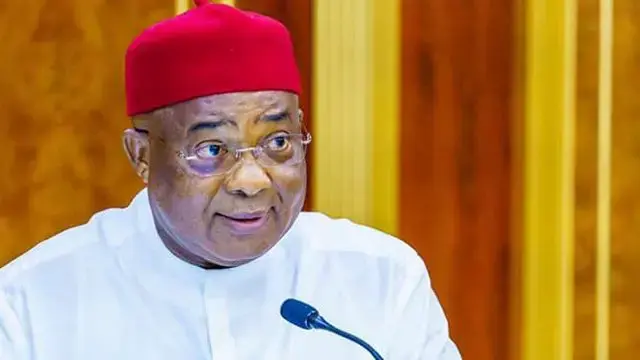
That question gained traction because the investigation has become linked to allegations surrounding the Progressive Governors’ Forum (PGF), the influential body of APC governors chaired by Senator Hope Uzodimma.
What began as a routine anti‑corruption inquiry has evolved into a controversy that touches on campaign financing, elite power arrangements, internal distrust among governors, and the increasingly blurred line between governance and partisan mobilisation before the next presidential cycle.
The issue first attracted public attention when the online outlet The Will reported that more than N800 billion had been pooled through entities called “Renewed Hope Ambassadors” and later “Renewed Hope Network,” structures allegedly connected to mobilisation for President Bola Tinubu’s expected re‑election.
The report claimed that governors elected on the APC platform made coordinated contributions from their states’ Federation Account Allocation Committee (FAAC) revenues.
These allegations turned what could have remained an internal arrangement into a constitutional, financial and highly sensitive national controversy.
FAAC allocations are public revenues distributed monthly among federal, state and local governments under Section 162 of the Constitution. When allegations emerged that portions of those funds may have been diverted into partisan structures outside formal public scrutiny, anxiety reportedly spread quietly across sections of the ruling party.
Governors who had once moved in careful alignment were suddenly asked private questions: How much was contributed? Who controlled the accounts? Who approved the transfers? Who benefited? And, perhaps most critically in Nigerian politics, who knew what?
Following the Money
Although the EFCC has not released detailed court filings or formal charges, investigators are tracing financial transactions allegedly linked to the movement of hundreds of billions of naira through various entities and accounts.
One source familiar with the probe described the investigation as part of a broader effort to establish how the money moved, who authorised the transactions and where the funds ultimately ended up.
“We are treating this as a serious money‑laundering case involving substantial movements of funds estimated around N500 to N701 billion. The Energy Commission DG was invited multiple times before we brought him in. Our focus is tracing the flow of these resources, which appear linked to the pooled contributions from some states,” the source told Saturday Vanguard.
The source added that investigators were attempting to determine whether “public‑derived funds were diverted or laundered.”
Inside the APC, however, the investigation is already generating another kind of tension.
Several sources familiar with internal discussions said concern deepened once the controversy stopped being treated as gossip and began attracting forensic scrutiny from the EFCC.
The fear in some quarters was no longer merely about headlines. It was about exposure—both to potential criminal liability and to vulnerability at a delicate moment when alignments ahead of 2027 are quietly taking shape.
One senior source said the investigation unsettled parts of the ruling party because financial arrangements that normally remain protected by internal trust had suddenly become subjects of public controversy and possible forensic examination.
In elite Nigerian politics, money is rarely just money. It is influence, access, leverage and insurance. Once questions begin emerging publicly around who controlled what, who authorised what and who benefited from what, relationships can become strained very quickly.
Still, another source within the governors’ forum defended the arrangement, insisting that the contributions were voluntary support efforts among governors.
“Look, the governors made voluntary contributions to support the Renewed Hope agenda ahead of 2027, this is normal political mobilisation, not a crime. The figure being quoted is exaggerated and taken out of context,” the source said.
The source also acknowledged that some governors later demanded explanations over the handling of the funds, leading to disagreements within the forum.
That detail may explain why the controversy quickly evolved into an internal problem for the ruling party itself.
Vote of Confidence on Uzodimma
As chairman of the PGF, Uzodimma now faces one of the most sensitive controversies confronting the ruling party. Reports of tension within the forum emerged after claims that some governors questioned how the pooled money was managed and whether proper accountability existed around the contributions.
There were also reports that a few governors quietly considered moves to challenge Uzodimma’s leadership before interventions eventually restored public calm within the forum.
Within APC circles, however, the episode appears to have triggered some questions. Several sources said the real concern inside the party was containment. That was achieved.
The APC could survive opposition criticism, they argued. What worried many more was the possibility of internal financial disagreements escalating into a prolonged public scandal ahead of 2027.
That concern reportedly triggered consultations, interventions and reassurance efforts aimed at preventing deeper fractures within the governors’ bloc.
Governor Uba Sani, who serves as deputy chairman of the PGF, publicly dismissed reports of serious division.
“At the moment, there’s no problem. All the governors are together. There was misunderstanding in the APC governors’ forum, but Uzodimma remains chairman,” he said. Similarly, Kebbi governor Nasir Idris moved the motion endorsing a vote of confidence in the PGF leadership.
Publicly, the governors projected unity. Privately, however, the controversy appeared to expose deeper anxieties about trust, control and accountability within the ruling elite.
That is partly because financing arrangements that usually remain hidden from public view suddenly became matters of national discussion. And once the financial structure inside a major power bloc becomes publicly contested, loyalty itself can become uncertain.
The Legal and Constitutional Grey Zone
The controversy has reopened debate about where political discretion ends and misuse of public trust begins.
The PGF itself is not a constitutional body. It is a caucus of APC governors. Yet the allegations suggest that funds tied to public revenues may have been coordinated for mobilisation ahead of 2027.




 English (US) ·