
ARTICLE AD BOX
David Easton defined politics as the authoritative allocation of values, while Harold Lasswell in 1936 described it as “It is about who gets what, when and how.” As predicted in January, 2026 is shaping up as a year of high‑wire politics because Nigeria is preparing for its eighth general elections in the Fourth Republic, which began in 1999. The country follows a quadrennial electoral calendar, having held polls in 1999, 2003, 2007, 2011, 2015, 2019 and 2023. The next, the eighth, is slated for 16 January and 6 February 2027, and the political temperature is rising as events unfold since January.
President Bola Tinubu signed the sixth Electoral Act into law on 18 February 2026. The legislation had been delayed by the National Assembly for reasons that many observers described as self‑serving. Nigerians had expected electoral reform to be a priority after the Senate and House of Representatives inaugurated committees to oversee the process in February 2024. A series of consultations, retreats and public hearings followed, with an original timetable that aimed for constitutional and electoral‑act amendments to be completed by mid‑2025, allowing sufficient time for implementation before the next general elections.
Lawmakers repeatedly moved the target date for the reforms. At one point they pledged completion by December 2025, a deadline that was not met. To date, no vote has been held on the constitutional changes that were widely anticipated. For example, women’s groups had hoped for an additional 47 seats across the Senate, House of Representatives and State Houses of Assembly, but the amendment process has been placed on hold, and the issue has not re‑emerged in public debate. Even the Electoral Act that was finally passed in February 2026 contains contentious provisions. The insertion of a proviso to section 60(3), which mandates electronic transmission of polling‑unit results in real time except where internet service is unavailable, sparked considerable controversy.
After the Act’s signing, several other sections were flagged as problematic. In March, the Inter‑Party Advisory Council (IPAC)—the umbrella body for registered political parties—warned that it might boycott the 2027 general elections if the controversial provisions of the newly enacted Electoral Act 2026 were not urgently reviewed.
IPAC expressed deep concern that certain sections could weaken Nigeria’s multiparty democracy and erode confidence in the electoral system ahead of the next national polls. A key issue highlighted was Section 84(2), which bars the use of indirect primaries for selecting party candidates. IPAC also demanded that “The mandatory electronic transmission of election results after announcement at polling units must be restored.” The council called for the removal of Sections 77(4‑7), which require parties to submit both digital and hard‑copy membership registers, for stronger penalties against vote‑buying, and for the reinstatement of forged academic certificates as valid grounds for election petitions.
Rather than addressing the ambiguities raised by IPAC and other civil‑society groups, the National Assembly amended the Act to designate the Court of Appeal as the final arbiter for pre‑election disputes involving state houses of assembly, the National Assembly and governorship contests. The amendment also empowers the Court of Appeal to hear pre‑election matters concerning presidential elections as a court of first instance, with appeals to the Supreme Court. It remains uncertain whether President Tinubu will sign these amendments into law, given that party primaries are already underway.
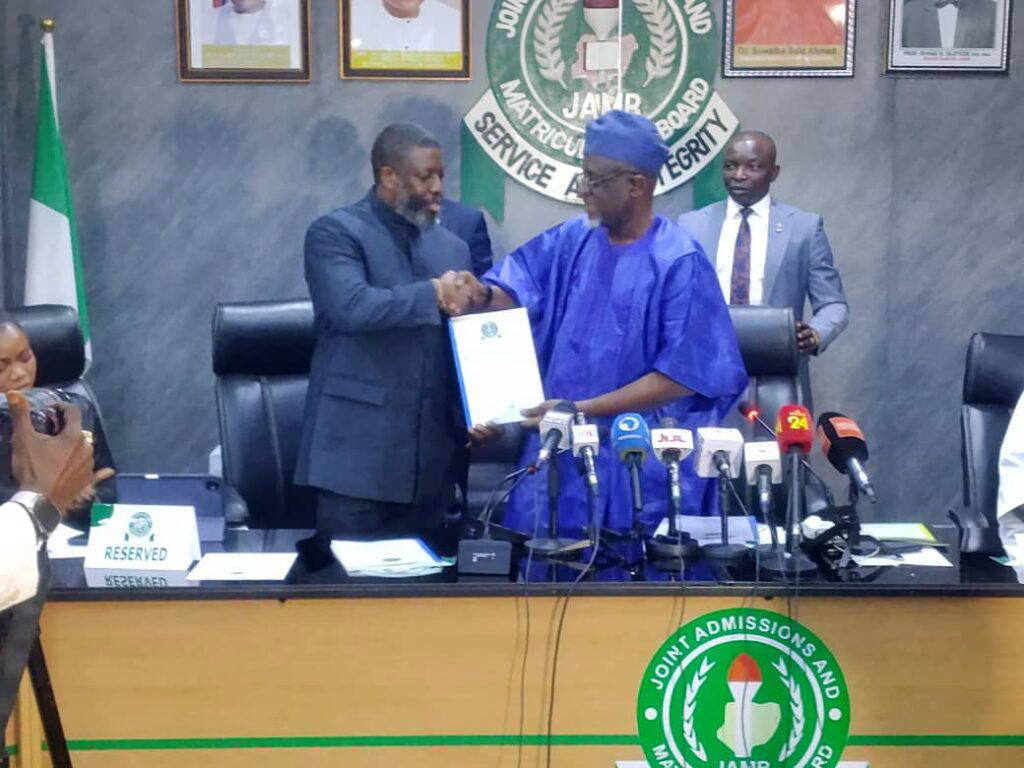
INEC Chairman Prof. Joash Amupitan announced on 5 February 2026 the registration of two new political parties: the Democratic Leadership Alliance (DLA) and the Nigeria Democratic Congress (NDC). He noted that the DLA met all legal requirements, while the NDC was registered following a Federal High Court ruling. Less than two weeks later, on 16 February 2026, Justice Mohammed Umar of the Federal High Court, Abuja Judicial Division, ordered INEC to register the National Democratic Party (NDP). These actions brought the total number of registered political parties in Nigeria to 22.
It is noteworthy that the National Democratic Congress, founded barely three months ago, has become the fastest‑growing political party in Nigeria as of today.
The NDC held its national convention on Saturday, 9 May 2026, in Abuja. The party zoned its 2027 presidential ticket to Southern Nigeria for a single term and pledged to zone the 2031 ticket to Northern Nigeria. This decision generated extensive political discussion, as many observers saw it as an incentive for former Anambra State governor Peter Obi and former Kano State governor Rabiu Kwankwaso to leave the African Democratic Congress (ADC), which they had joined only two months earlier, and to join the NDC on 3 May 2026. Obi had formally registered as an ADC member in his ward in Agulu, Anambra State, on 7 March 2026.
Obi’s departure from the ADC occurred less than two months after his registration, taking many of his supporters in the “Obidient” movement with him. Analysts suggest that Obi did not receive a firm commitment from the ADC to zone its presidential ticket to the South, and he feared that remaining in the ADC would force him into a joint ticket with former Vice President Atiku Abubakar—who was expected to defeat him in the ADC primary—potentially relegating him to the position of running mate in 2027. This scenario mirrors the 2019 election, when Atiku and Obi ran together under the Peoples Democratic Party. Critics have labeled Obi’s move as selfish, but supporters argue that he acted to avoid a secondary role that could jeopardize his political future, especially given the expectation that power would shift back to the North for eight years after 2031. Kwankwaso is believed to have agreed to




 English (US) ·